
Risks#
Generative AI has the potential to facilitate learning, but it also brings risks that can quietly weaken the very skills education is meant to develop. At their core, these risks reveal how the traditional approach to education is incompatible with generative AI. When our systems for delivering and assessing knowledge remain unchanged, AI turns into a replacement for learning instead of a tool. Some of these risks include:
With AI ready to recall facts, explain concepts, and solve problems, students may bypass the mental work needed to store and connect knowledge. While strategic offloading can be useful, overuse leads to weaker foundational skills and less independent problem-solving ability.
Some students become adept at working with AI but struggle without it. This dependence can cause abrupt performance drops in exams, interviews, or real-world tasks where AI is unavailable or inappropriate.
AI can instantly generate polished work without the student engaging in the underlying thinking. This makes it harder to know whether a submitted piece reflects genuine understanding or simply skilled prompting.
If content can be learned outside of the classroom with AI, students can lose interest in going to class. Furthermore, they may struggle to see the importance and value of their effort if an AI tool can create the same without any problems.
Access to AI tools varies widely between students. Those with better devices, technical literacy, or paid subscriptions gain faster, more tailored help, leaving others at a disadvantage. Over time, this can widen achievement gaps and create two different learning experiences in the same classroom.
AI can confidently produce content that is factually wrong, outdated, or biased (an hallucination), and students may not have the skills to detect it. This can reinforce misconceptions or spread false information.
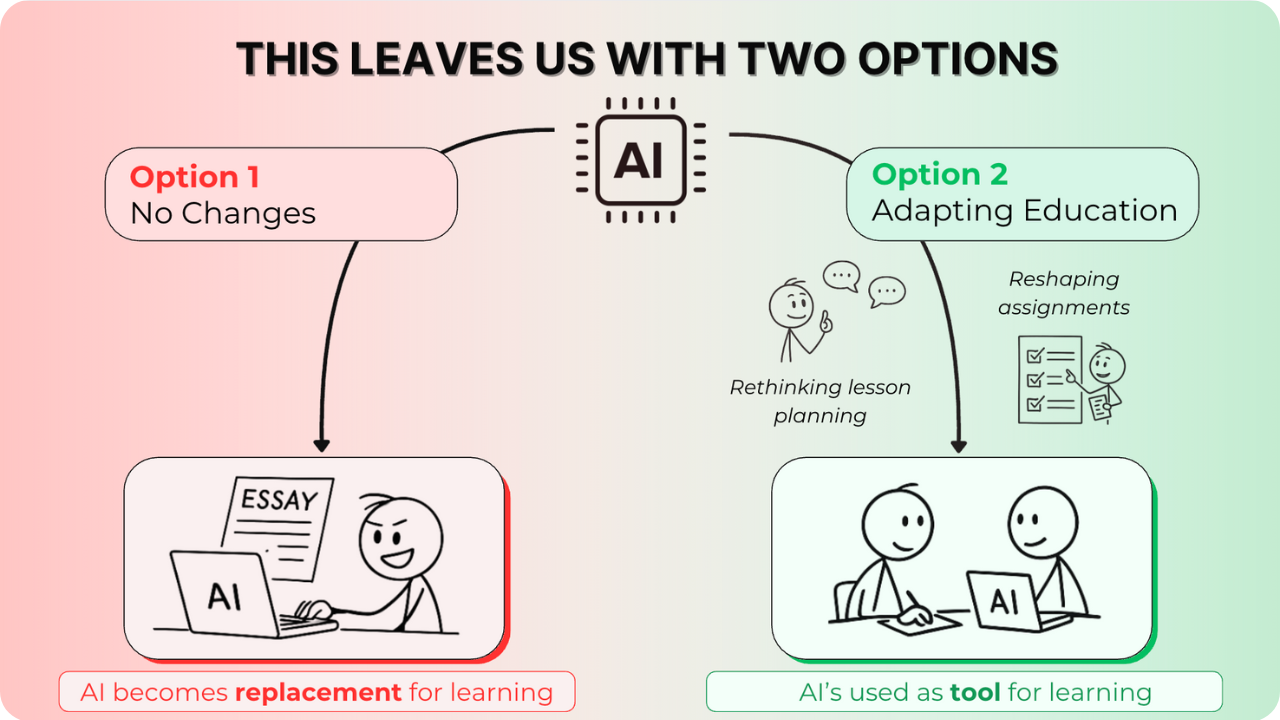
Although these risks look different, they share the same root problem: they thrive in an outdated learning environment designed for a pre-AI world. The good news is that the solution is within our reach. The chapters ahead outline exactly what changes are required, from rethinking lesson design to reshaping assessments.