
The Books Al Companion#
Using Your Personal AI Companion#
This companion is a custom GPT connected to the complete knowledge base of this book. It gives you personalized guidance tailored to your teaching context, helping you understand and apply what you read. Use it throughout this book, as the more you use it, the more useful it becomes.
Let’s start by creating a personalized roadmap. Paste this prompt into the custom GPT and it will ask clarifying questions to build a learning path for you:
I have just started using the book and would like your advice on the best way to utilise this resource. Based on my personal context I’d like you to give me advice on both how I should use the book and how I can utilise this customGPT.

Ways You Can Use This#
If a concept in the book isn’t clear, ask the assistant to re-explain it in simpler terms, provide an example, or connect it to your specific teaching context.
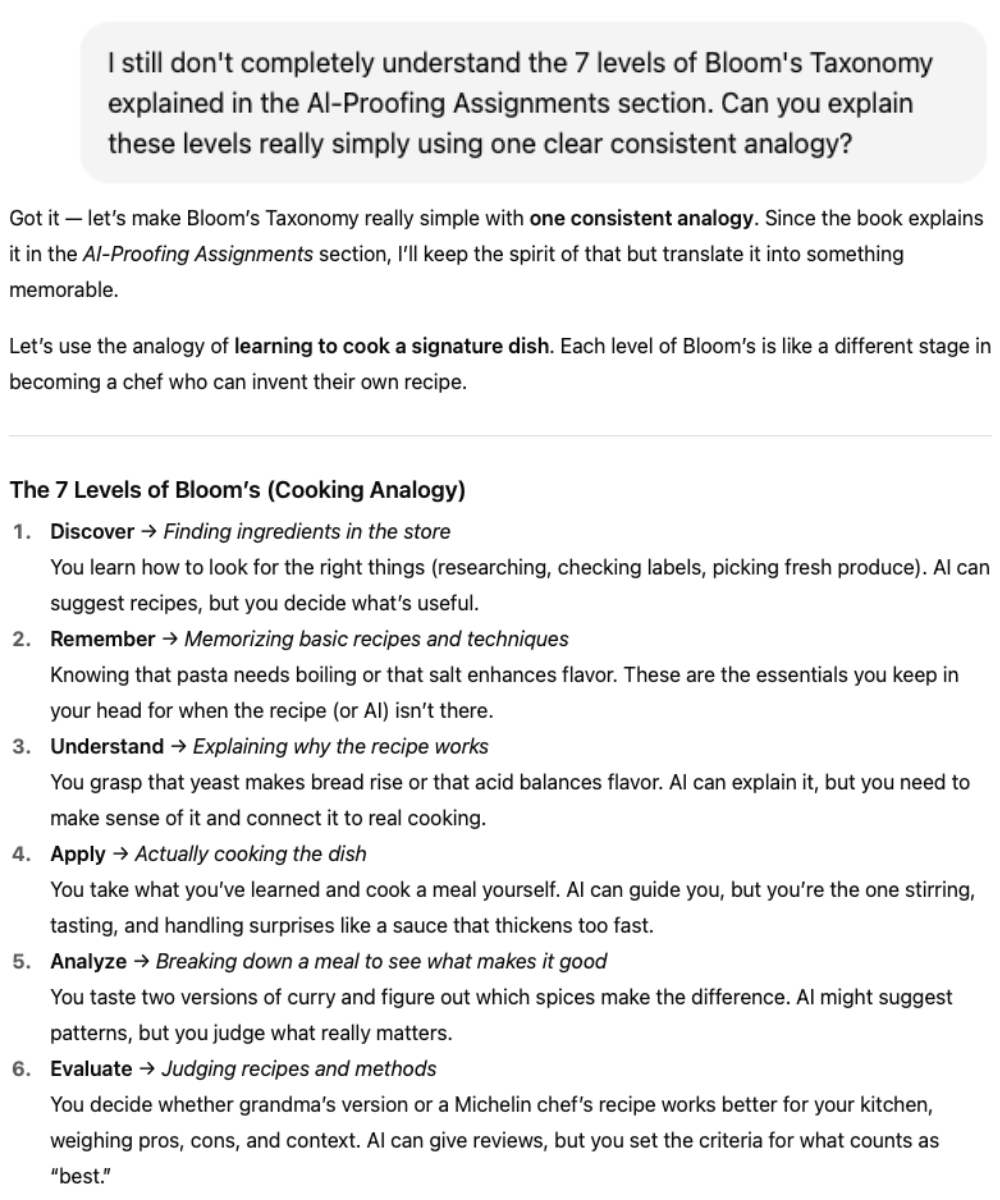
You can get personalised advice building on these principles. Simply give context ask if it needs more clarification and get tailored advice.
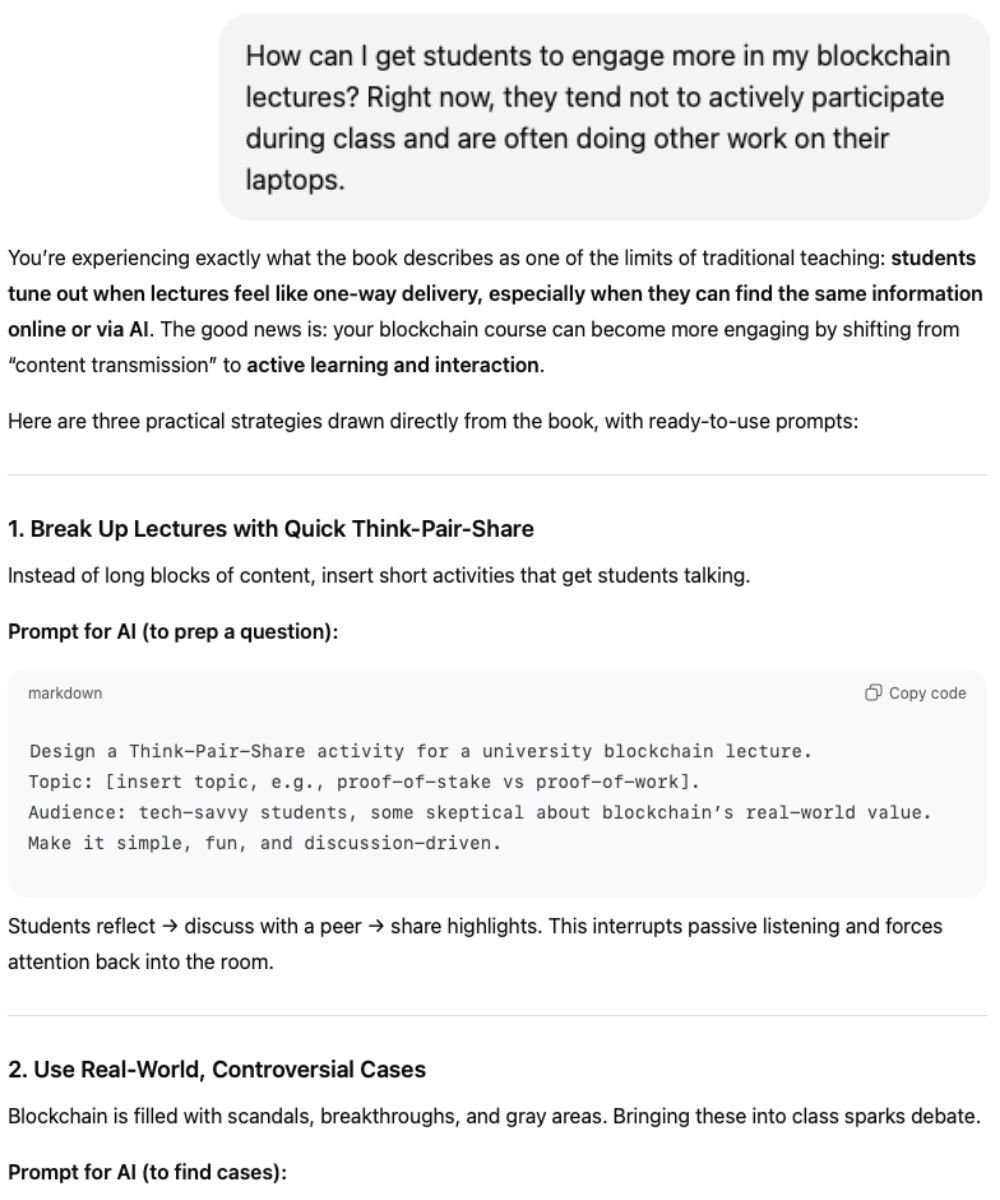
The assistant can easily provide ready-to-use prompts that you can copy, paste, and adapt. For more complex tasks, it can also generate step-by-step workflows to guide you through more detailed processes.
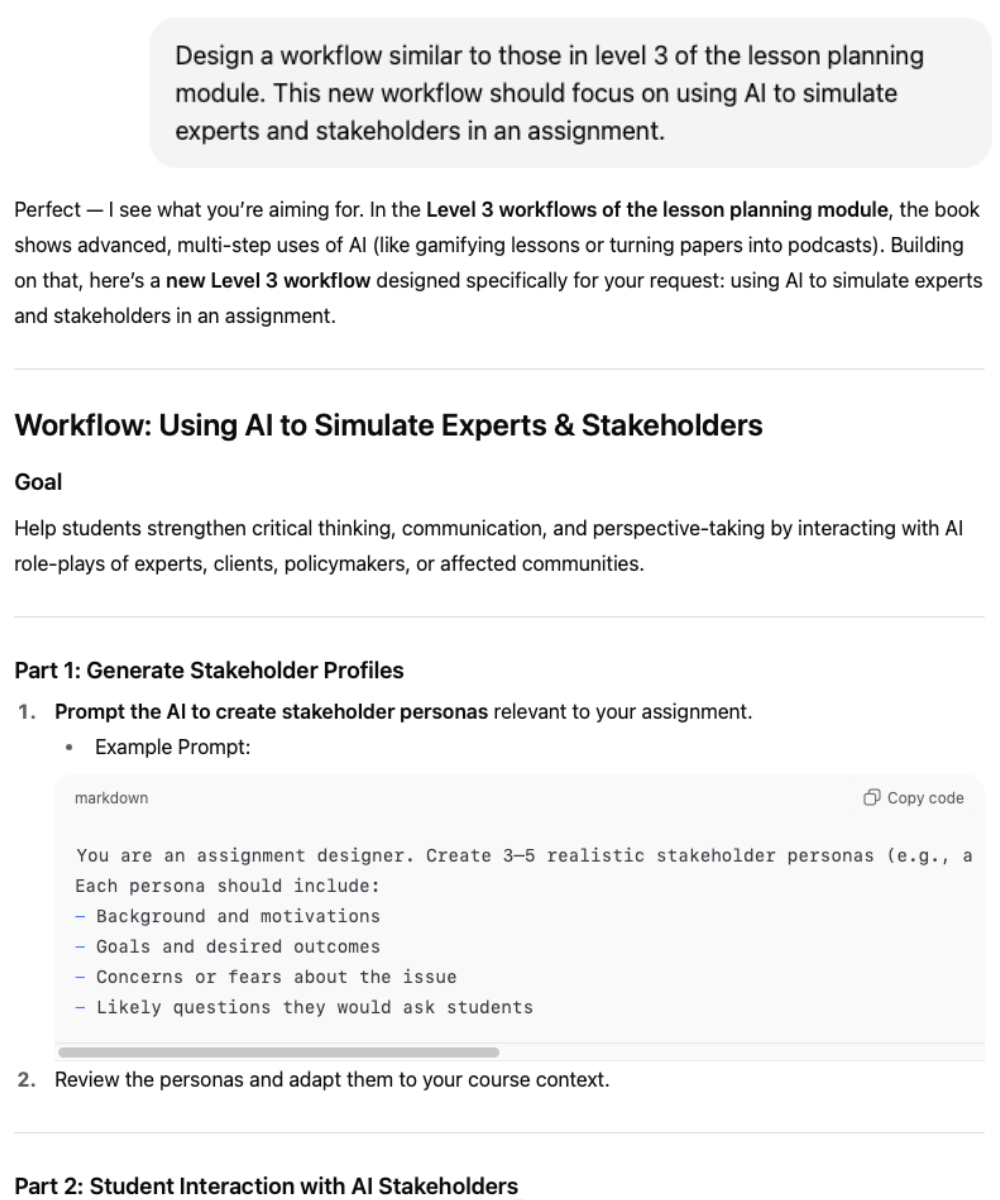
Craft personalised assignment ideas, exam questions, or project guidelines that are AI-resilient.

The possibililities of using this GPT are endless. For example, you could request a summary of any section formatted as a story or metaphor, generate reflection questions to deepen your understanding, or create mini-quizzes to check your knowledge. Curious to see more, use the following prompt:
Please show me the best unique ways I can use this custom GPT as a really good guide to the book (going beyond the uses for the AI companion already discussed such as better understanding and personalising content). To ensure the uses are personalised ask me 5 questions that will improve the response you will be giving me. Wait for my response before continuing.
How This Assistant Was Built
This companion is a custom GPT built on OpenAI’s ChatGPT platform. I chose ChatGPT because it’s one of the most widely used AI tools in education, making it accessible and familiar to most readers. I’ve also worked with custom GPTs before, which made it the practical choice for creating something I could easily share and maintain.
What’s included: The assistant has access to the complete manuscript of this book (every chapter, section, and example). This means when you ask it questions, it’s drawing directly from the content you’re reading, not just general AI knowledge. I’ve also enabled web search, Canvas, image generation, and code interpreter to make it able to handle many tasks and stay up to date.
Why use this instead of regular ChatGPT? The custom GPT is specifically configured to act as a teaching coach grounded in this book’s approach. It will always reference the book’s principles first, then extend beyond them when useful. It communicates like a supportive colleague rather than a generic AI, and it’s designed to give you concise, practical guidance.
Custom instructions: I’ve configured the GPT with specific instructions that shape how it responds. This includes things like prioritizing book content, asking clarifying questions before generating outputs, staying practical rather than theoretical, and flagging “Extension beyond the book” when it’s extending beyond the source material. These instructions help ensure consistency and transparency.
Data and privacy: As with any AI tool, be thoughtful about what you share. Avoid pasting sensitive student data, confidential institutional information, or anything you wouldn’t want processed by a third-party system. For general pedagogical advice, lesson planning, and understanding concepts from the book, this assistant can be incredibly helpful.
A work in progress: This custom GPT will continue to evolve as I update the book and learn from how educators use it. If you notice anything that should be improved, or if something doesn’t work as expected, please contact me at (m.a.a.jacobs@student.tudelft.nl) so I can keep improving this tool.